

A whole-person framework for the dementia journey
The GRACE Method is the only dementia care approach that integrates neurological understanding, emotional attunement, environmental structure, and spiritual engagement into one cohesive, compassionate framework.
Something has been missing in Dementia Care
For decades the dementia care industry has approached this diagnosis primarily through a clinical and behavioral lens — managing symptoms, correcting behaviors, and structuring environments around compliance and control.
The result is a system that prioritizes calendars over connection, correction over compassion, and schedules over souls.
Residents are agitated — and no one is asking why. Caregivers are burned out — and no one is equipping them.* Families are grieving — and no one is walking with them.* Churches want to help — and no one has taught them how.*
The GRACE Method was built to change that — by addressing every dimension of what it means to be human, even when the memory is changing.
grace is more than a word. it is a way of caring.
The GRACE Method is a whole-person dementia care framework developed by a Certified Dementia Practitioner, memory care nurse, and ordained minister with decades of clinical and pastoral experience.
It was born out of a simple but revolutionary conviction:
“We should never prioritize correcting them over connecting with them.”
GRACE addresses five essential dimensions of whole-person dementia care — the environment, the brain, communication, emotions, and the spirit. Together these five pillars create a comprehensive approach that transforms how caregivers, families, facilities, and faith communities show up for people living with dementia.
G — ground the environment
The environment is not just a backdrop — it is a direct contributor to the emotional and behavioral experience of a person living with dementia.
Overstimulating, chaotic, or unpredictable environments trigger agitation, fear, and combative behavior. Rigid activity calendars that leave no room for individual needs and rhythms create frustration for residents and caregivers alike.
Grounding the environment means creating structure without rigidity. Safety without sterility. Calm without confinement.
It means asking not 'how do we get them to comply with our schedule' but 'how do we build a world that makes sense to them.
Practical Application
What this looks like in practice: Consistent daily rhythms that reduce anxiety. Sensory-appropriate spaces that minimize overstimulation. Flexible programming that honors individual preferences and energy levels. Environmental cues that support orientation and safety.
r — recognize the brain changes
Dementia is not stubbornness. It is not manipulation. It is not a personal attack on the caregiver.
It is a neurological reality — and when caregivers truly understand what is happening inside the brain, everything changes.
Shadowing — when a person follows their caregiver everywhere — is not annoying behavior. It is a profound expression of trust. It means you are their safe person.
Repetitive questions are not defiance. They are a broken memory loop — the brain genuinely does not retain the answer.
Confusion is not a choice. It is the brain doing its best to navigate a world that no longer makes complete sense.
When caregivers recognize the brain changes behind the behaviors, frustration gives way to compassion. Correction gives way to connection. And care becomes something entirely different.
Practical Application
What this looks like in practice: Understanding the stages of dementia and what to expect at each one. Learning the neurological reasons behind common behaviors. Replacing frustration with curiosity — asking 'what is this behavior communicating' instead of 'how do I stop it.
a— Adapt communiaction and care
The single most common mistake in dementia care is trying to bring the person with dementia into our reality instead of stepping into theirs.
Correcting, redirecting, and arguing with someone whose brain can no longer process reality the way we do does not work. It creates distress, agitation, and disconnection — for everyone.
Adapting communication means meeting them where they are. It means speaking in short, calm, clear sentences. It means using touch, tone, and presence as powerfully as words. It means never arguing about what is real and instead asking what they are feeling.
It means choosing connection over correction — every single time."
Practical Application
What this looks like in practice: Validation therapy techniques that honor the person's emotional reality. Non-verbal communication strategies using touch, eye contact, and tone. De-escalation approaches that prevent and reduce agitation. Person-centered language that preserves dignity at every stage.
c — Comfort the emotional world
Here is something medicine has consistently underestimated about dementia:
A person living with dementia may not remember what you said. They may not remember your name. They may not remember what happened five minutes ago.
But they will remember — deeply and lastingly — how you made them feel.
The emotional world of a person with dementia is not diminished by the diagnosis. It is often heightened. Fear, grief, loneliness, joy, love, peace — these experiences are fully alive even when memory is fading.
Comforting the emotional world means showing up with presence, patience, and the understanding that feelings are the last language dementia takes. It means creating moments of genuine connection — moments of laughter, of peace, of being truly seen — that the person carries long after the conversation is forgotten."
Practical Application
What this looks like in practice: Emotional validation techniques that acknowledge and honor feelings. Creating moments of joy, laughter, and genuine connection. Recognizing and responding to emotional distress with compassion rather than correction. Understanding grief — both the patient's and the caregiver's — as a central part of the dementia journey.
e — engage the spirit
This is the dimension of dementia care that clinical training almost never addresses — and it may be the most powerful of all.
Long-term memory is often the last thing dementia takes.
This means that hymns sung in childhood are remembered long after family names are forgotten. Scripture memorized decades ago rises to the surface when recent memories cannot. The melody of a familiar worship song can reach a person that medicine alone cannot touch.
The spirit does not have dementia.
Engaging the spirit means honoring the whole person — not just the brain that is changing, but the soul that remains. It means incorporating faith, music, prayer, ritual, and spiritual presence into dementia care as essential tools — not optional extras.
This is where the Church becomes one of the most powerful caregiving communities on earth. This is where the family caregiver becomes a minister of presence. This is where clinical care becomes something holy.
And this is why GRACE exists
Practical Application
What this looks like in practice: Incorporating familiar hymns, scripture, and spiritual rituals into daily care. Training faith communities to provide meaningful ministry to members living with dementia. Creating worship experiences that are dementia-friendly and spiritually engaging. Recognizing and honoring the spiritual identity of every person in your care.
take the grace method with you —anytime, anywhere
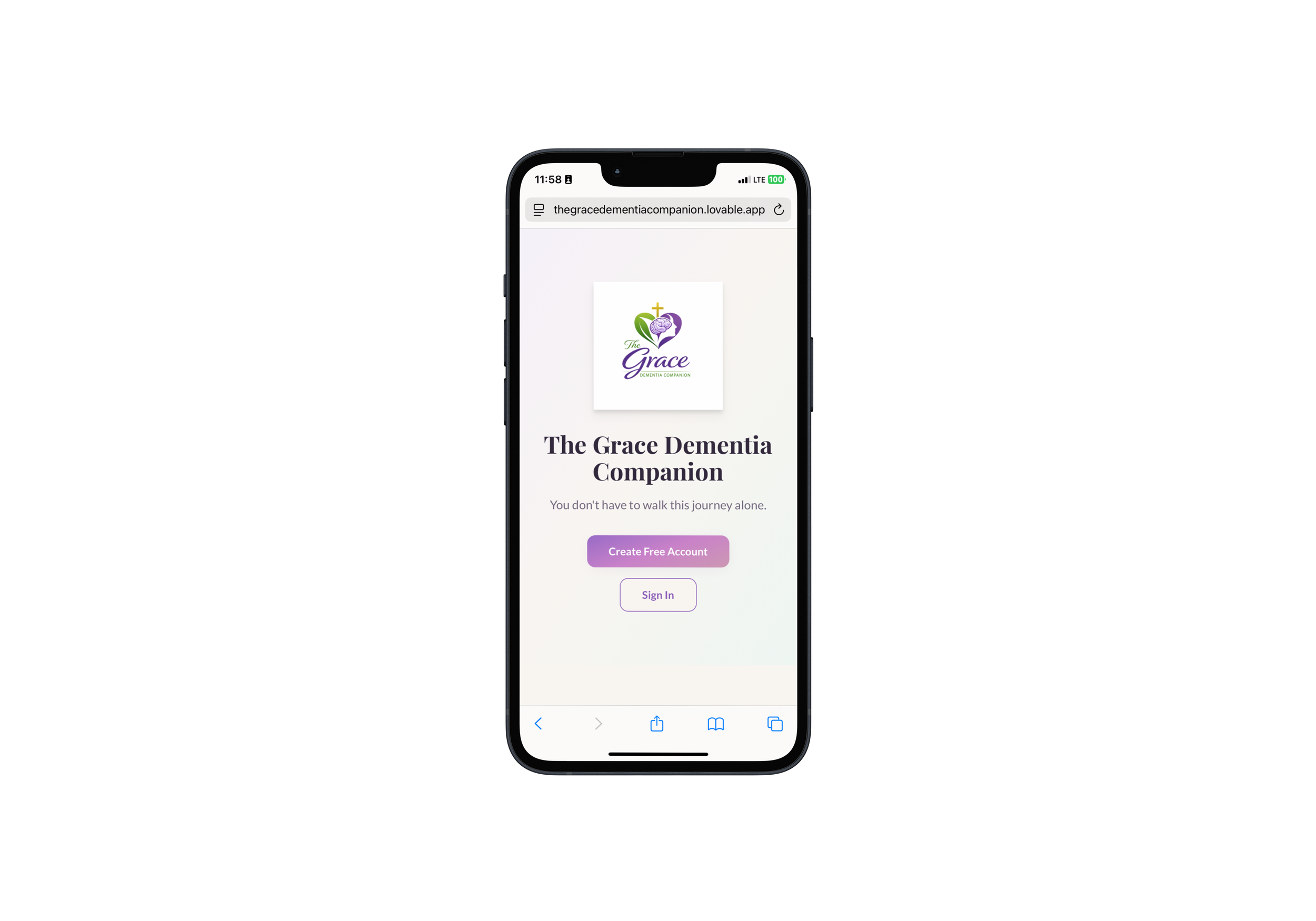
The Grace Dementia Companion app puts the power of the GRACE Method in the palm of your hand. Get AI-powered guidance, learn the five pillars at your own pace, track behaviors, and access caregiver support — completely free.
Because this journey doesn’t just happen during business hours.
grace was built for every person on this journey
Are you ready to bring GRACE into your care?
The GRACE Method is available through workshops, one-on-one consultations, facility training, and faith community education. Choose the path that is right for you — or start with a free conversation.